Does the definition of your corporate culture really make you successful?
Define corporate culture? What for?
At a congress the other day:
I leave the stage where I have just given a presentation on corporate culture. A middle-aged man rushes up to me with a grim face: “Why define our corporate culture? – I’ve already done that. It’s all on our website. But it didn’t help either.” Once he’s got that out of his system, he introduces himself as Peter, Managing Director of a large engineering company. I ask: “Was that a team effort? Did you all do it together?” He frowns: “Why would I keep my people from work for something like that? In my company, we have to deal with real problems. We all have work to do. We can sit down and chat when we have time and money.”
We encounter this attitude time and time again.
And of course – why string together some euphonious words of praise in a circle of chairs?
But that’s not the point.

Your corporate culture
By talking as a team about your corporate culture, i.e. how you work together, you have the chance to identify your frictions, problems and imbalances and ensure that you pull together as a team in the long term. After all, as countless studies have shown, a company is only successful if the team works well together. If part of the workforce is only dragging themselves to work for the money, then you can’t expect top performance, but rather work to rule, high sickness rates and staff turnover.
Defining corporate culture is therefore anything but a “can do, but don’t need to”, but an opportunity to get to the root of problems and solve them in the long term. And if things are going well in the company, this not only saves time and money, but also generates significantly more profit.
We’ll show you what you need. And that you can make a real difference in a short space of time with little effort.
Criticism of corporate culture
I offer Peter a free consultation.
By the way: You are also invited to a non-binding, free meeting so that you can get an impression of our work and check whether and how your company would benefit from it. And most importantly: whether it’s a good fit on a personal level.
Peter makes a stunned face. He hadn’t expected this. He was actually looking for a debate and wanted to express his mistrust of cultural issues. With his 54 years, his standing as a managing director for many years, his degree in mechanical engineering and his professional experience in a wide variety of positions, he has, as he states: “…already experienced many trends that management consultants proclaim. Something new every year. Costs a lot of money, but doesn’t add any value.” “I can understand that,” I say, “I can reassure you: Our conversation will only cost you your time and you decide what added value it has.” Peter nods approvingly: “I’m really looking forward to it. Right, let’s do it.”

Hi, I’m Susanne,
management consultant, change manager and author of the book Corporate Culture as a Success Factor.
I invite you to a free and non-binding consultation. We’ll talk about how you can use your corporate culture as a strategic tool.
If you have any other questions about corporate culture and change management, just get in touch with me!
1 What is corporate culture?
Definition of corporate culture:
Corporate culture describes how the people in a company interact with each other, which values, norms, structures and behaviours characterize the company and how the organization appears to the outside world.
Description of corporate culture:
Simply explained: The term corporate culture describes the atmosphere in and around a company through various factors such as values, manners, rules, style, power structures, processes, communication methods and reward systems. Every company has a different culture.
How does corporate culture manifest itself?
Do employees tend to treat each other in a formal, reserved manner or in a casual and open way? Are there strict hierarchies or rather self-organization and co-determination? Tie or sneakers? Are there processes that must be adhered to uncritically at all costs or does everyone always work constructively to optimize processes? Is the interior rather gray and serious or colorful and modern or is no value placed on it at all? Is communication open or behind closed doors? Does the person who stands up to the others get the bonus or is the whole team rewarded?
As you can see, similar to the description of a country’s culture, many very different practices, structures and attitudes flow into the definition of a corporate culture, which together make up the look and feel of a company.
Every corporate culture is based on the values of the company and, of course, those of its employees; in other words, what people consider to be important.

Define corporate culture
First things first: defining your organizational culture doesn’t just mean finding words for the current state of your cooperation! No – above all, it’s about defining the target state. In other words: the culture that makes your company and the people in it as successful as possible.
And – very importantly – how you get there. How can you implement this in your company on a daily basis? How can you become top performers as a company, as a team?
Is corporate culture a luxury topic?
A week later, I meet Peter at the team meeting.
I smile at him: “Nice of you to accept my invitation, Peter.”
Peter, in a slightly better mood today than when we first met, replies: “Yes, I wanted to see what else you do. We have all sorts of problems, so maybe we could do with some management consultants. But we don’t really need a corporate culture, we can manage that on our own.”
I ask: “Ok – what are you doing in terms of culture? How would you describe your current corporate culture?”
Peter rumbles: “Well, corporate culture… It’s such a feel-good thing. What are we supposed to do? To be honest – of course my people should be happy, but we all come to work. That’s not always nice. Not for me either. Should I set up a table tennis table now? I mean, they all get a good salary. What else?”

Why is corporate culture important?
Corporate culture seems to be a very soft topic that makes you wonder whether it is really that important. And yes: it is! But why? Because it has a direct influence on the success or failure of your company.
Performance
The culture of your company has a concrete impact on its performance: it can meet the demands that customers and the environment place on your organization, but it can also act as a brake. Want an example? If customer requests have to be implemented very quickly, then a bureaucratic culture is more of a hindrance. On the other hand, employees who can make their own decisions quickly are helpful.
Employee motivation
Another point is employee motivation, as this is one of the most important factors for the success of your company: if people feel comfortable in your company, they will be much more committed to their work than people who have long since given notice.
Employee retention
And your corporate culture not only has an influence on internal resignations, but also on employee retention, because if the atmosphere and/or general conditions are counterproductive, employees will quickly leave the company.
Young talent
For members of the younger generations in particular, the working atmosphere, values and meaningfulness of an employer are very important. If your company is looking for young talent, it is worth taking a look at its own corporate culture. This is the only way to achieve authentic employer branding.
In our article Corporate culture & cultural change: definition, examples & 11-step tutorial, you can find out everything you need to know about corporate culture and how you can measure and change it.
Classic cultural conflicts
Peter frowns thoughtfully: “I hate to admit it, but you have a point. We always have friction between the departments: Sales and production is a constant source of friction. I don’t know what’s going on all the time. I just want it to work. I can’t play kindergarten teacher – they’re all grown-up people!” And after a short pause, he adds: “Some of them have left. They were good people. We can’t really afford that. It’s incredibly difficult to find new employees. And the new
What is a positive corporate culture?
A corporate culture is helpful if the people in the organization feel comfortable with it and if it simultaneously lays the foundations to meet the challenges in the environment today and in the foreseeable future.
This definition sums up two central aspects:
- Employee well-being – i.e. emotional security, identification, a sense of belonging.
- Future viability of the organization – i.e. orientation, ability to act and adaptability to the outside world.
Both together are the benchmark: a culture that is only cuddly but does not contribute to the achievement of goals falls short. The same applies vice versa: Pure efficiency without a cultural fit generates frustration and fluctuation.

2 Why is it important to define your corporate culture?
“So, Susanne, let’s put our money where our mouth is,” Peter calls out boldly, “what would we actually gain from getting involved in this cultural history? How would that help us with the problems we have?”
2.1. Clarity:
How your clearly defined corporate culture helps guide employee behavior
Many companies describe their corporate culture with flowery words such as appreciation, team spirit and innovation. Sounds great and is put on the website so that customers and new employees are attracted by so much inner beauty. This is the definition of corporate culture written for the outside world.
However, a well-described culture is at least as important for the internal world of the company! Why?
Orientation
With a well-defined corporate culture, you can enable your employees to act independently AND in line with your corporate goals. To do this, you should define your goals so that it is clear where you want to go. And you need a description of what behavior is desired and within what framework. For example:
- Can I decide on my own or do I have to ask my boss?
- Do we prefer flexibility or discipline and adherence to rules?
This gives you a common understanding of how to complete the tasks at hand. This makes work easier for employees and management alike.
And onboarding processes also run much more smoothly for everyone involved if people who are new to the company know how things work straight away.
Desired behavior
Let me use an analogy to illustrate how the definition of your corporate culture affects you.
A well-described corporate culture is like a guardrail on a highway: the (destination) direction in which you are driving is clear and the lane is defined by the guardrail. Within this framework, drivers can react independently to the current (traffic) situation, for example by changing lanes, speeding or overtaking.
However, if such a framework is not clearly communicated, managers and employees must constantly coordinate whether planned actions are in order. Not only is this time-consuming for everyone, but employees also often feel like they are being controlled.
Feedback
If you have agreed on things like goals and behavior, then it is also clear which behavior is not desired. And if things go differently, you have a basis for giving each other feedback: you can always compare where you stand in relation to what you have set out to do.
By defining your corporate culture together, you can also talk about behavior that happens unconsciously. In this way, you have a great influence on shaping your cooperation in a positive way for everyone.
Source of error
Very important: of course, the corporate culture you have defined must also be lived and integrated. And by everyone! If, for example, it is officially desired that you act and make decisions independently, but the boss interferes in every decision, no matter how small, then the description of your corporate culture remains nothing more than a collection of pious words.

One goal or many directions?
I ask: “Can you do anything with that, Peter?” – “Yes, I can. I just mentioned that some departments are almost working against each other: When marketing promises customers great features, the engineers beat their hands over their heads because it’s still taking time to develop. And then they clash and the managers have to deal with sensitivities. That slows us all down. It’s as if everyone wants to go in a different direction.”
2.2. Communication and identity:
Why you develop a strong identity by defining your corporate culture.
Among other things, identity also means belonging. People who identify with their club or hobby achieve a great deal in these areas and accomplish great things in their free time without being paid. A level of commitment that most companies can only dream of.
But identification does not arise when your managing director sits down with two division heads in a small room and decides what your corporate culture should be. Where is a sense of belonging supposed to come from? Things are very different when the employees themselves are asked about their values, perspectives, challenges and expectations. If everyone can get involved and help shape the mission statement and cultural definition so that everyone in the company really feels “wow, I was there!”, then they can also identify with it. The journey is clearly the goal here.
Loyalty
“Interesting,” mumbles Peter, “I thought identification would come naturally over time. So the employees who have been with us for a long time, we can rely on them. They sometimes work longer without grumbling if it’s important. But there are also employees who know that the pencil drops at 5 o’clock. They have other priorities.”
“Are you talking about certain people?”
“Yes, the young people. At the beginning, they want to know everything exactly instead of just walking along and having a look. And then they want to change everything. There’s a new idea every day. And then they lose interest if it doesn’t go the way they want. How is identification supposed to come about if you do everything badly?”

2.3. Recruitment and employee retention:
How your well-formulated corporate culture attracts the right talent and retains employees in the long term.
Recruiting
Employer branding is important, no question about it. – A well-formulated corporate culture can have a very positive effect on websites and career portals and attract potential employees. However, this only scores points if the culture described there is actually lived in the company. Because if the new employee has high expectations of the corporate culture due to the positive description and then finds a completely different situation, no one is helped. It only costs everyone involved time, money, work and nerves if the new employee resigns disappointed after two months.
This is not only frustrating, but also enormously expensive:
- Recruiting has to be paid twice.
- The costs for the induction are incurred twice: These are not only costs for the new employee, but also for the colleagues who invest time in this and cannot do their normal work.
- The things that naturally don’t run smoothly during the induction phase and then have to be corrected also cost working time.
- The frustration of employees when they have to do the work twice costs motivation.
- There may also be a bad employer rating.
In other words:
An unrealistic description of your corporate culture will cost your company a lot of money!
Retain talent
What does that mean for you? It means that it’s not enough to attract the right talent, you also have to make sure they stay with the company!
However, a well-defined corporate culture alone does not retain employees; in order to do so, the culture described must actually be lived. This requires everyone in the company: The topic of corporate culture should be discussed in every team. Discuss with each other what concrete actions can be used to put your culture into practice in your day-to-day work.

Criticism: corporate culture as a trend
Peter nods thoughtfully: “I wouldn’t have thought that this also has to do with your cultural topic. Yes, we’re also desperately looking for good people. The things you have to come up with these days! Employer branding. Who would have thought that before. I mean, we are a good employer; we pay more than others. But young people seem to need a red carpet.” “Well,” I say, “preferences have changed and they will continue to do so.” “So we’re supposed to chase after every trend?” “No, not at all. But you should be able to create an environment in which employees want to give their best.”
Keeping corporate culture up to date
Ideally, there is a permanent cultural process. An initial cultural process takes about a year and a half. After that, we believe that a permanent team is needed to continue dealing with the topic of corporate culture. This is because a company’s culture changes, especially in turbulent times like ours. When the company changes or adapts to new circumstances, the culture changes too.
And that’s why it pays to stay on the ball:
- in the teams again and again,
- the description of the corporate culture up to data
- and to define the specific actions.

3. how can corporate culture be described?
Why it is important to be as specific as possible.
1. define values
Most of our customers love to describe their corporate culture by mentioning values. We then hear words like “innovative” or “customer-centric”. Sounds great, but such a value is of little use if it is not backed up by a guiding principle.
Values for employer branding and marketing
I ask Peter to define the culture of his company. “Wait, I’ll have to have a look.” I can see on my screen that he is looking for something on his computer. “There! I’ve got it,” he says pithily, looks briefly at the camera and reads out: “Reliability, workmanship, team orientation. That’s what it says on the website. Here are a few more.” I interrupt him: “Let’s focus on one of these values first. Team orientation. What does that even mean?” I want to know. “TEAM = Great, Another does it, that’s what it says on our office mugs,” Peter jokes good-humoredly.
2. define guiding principles
Guiding principles define the behavior that emerges from a value. How should you act and treat each other based on the value?
You can visualize the relationship between values, guiding principles and behaviour: one circle represents the value. A second circle surrounds the value – this is the guiding principle. A wider circle surrounding the guiding principle symbolizes the behaviour.

Me: “What do you expect from your people in terms of team orientation?”
Peter: “Mmh, well – respect; that you treat each other well and stick to agreements. Otherwise everything goes haywire. Yes, and that you keep each other up to date and let each other know when something happens. We’ve had some real trouble there.”
Team orientation, for example, can be equipped with the following guiding principles:
- We treat each other as equals, regardless of hierarchical level.
- If we have promised each other something, then we reliably keep it.
- We regularly pass on our information to the team.
These are concrete guidelines for action.
3. define behavior
Now it’s time to get even more specific! So, in which situations – based on the guiding principles – should action be taken and how exactly?
Difficulties
I ask Peter: “When would you have liked your employees to have acted in accordance with the guiding principles? Where would you have needed equality, reliability or a better exchange of information?” Peter sighs: “We once missed out on a huge deal because one hand didn’t know what the other was doing: someone from the service department asked the customer on a regular basis whether they would like to order wear parts. The customer’s employee declined because a new machine was to be purchased. Joah, we would have liked to offer him that – but our colleague kept it to himself.”
Examples of behavior in terms of team orientation:
- The service department keeps the sales department up to date on potential customer requirements.
- There is a problem and people from different departments get involved to solve the problem together.
4 Why integrate corporate culture into mission and vision?
How mission and vision should reflect and reinforce the corporate culture.
Definition of mission and vision
The mission – The assignment
The mission, the purpose, i.e. the reason why the company exists. For an automotive company, for example, this could be: “We make people mobile and self-determined.”
The vision – the direction
The vision describes where the company wants to be in three, four or five years’ time. For example, a real estate company from Hanover would like to be the market leader in all relevant service areas.
How can your corporate culture reflect your mission and vision?
When you start a cultural process in your company, the mission and vision should already be defined.
Before employees are asked about values, the definitions of mission and vision should be made clear once again. Finally, the desired corporate culture (see question 3 below) should help to ensure that the mission is lived and the vision is achieved.
The following questions are then asked on the basis of this orientation:
- What are the personal values of the people in the company?
- What values are currently practiced in the company?
- What values are needed for the company to be successful in the future?
Creating the ideal environment
Peter reflects: “Calibrating the direction – we could do with that. That’s very clear. You know, as an engineer, I look at where there’s a problem and then I solve it. And the culture thing was just too wishy-washy for me. But I understand what you mean: just like some materials need a certain temperature to work, you need a kind of internal culture so that employees can work better, I’ve understood that so far.” Personally, I find it difficult to compare people with materials, but I’m still pleased with Peter’s insights: “Something like that.”

5. the components of corporate culture :
Which cultural factors should you describe?
Corporate culture doesn’t sound very tangible at first, but it manifests itself on various levels.
- Behavior, rules and rituals
This is about how you deal with each other, which unwritten norms apply and which recurring processes are part of your everyday life. Having breakfast together, daily team discussions, the way mistakes are discussed – all of this shapes the internal climate.
- Symbols and working environment
The furnishings, the style of the rooms, the clothes you wear at work and status symbols send messages about how you can and should be in the company. Open spaces or individual offices? Casual dress or formal dress code? Company car or bicycle? These elements reflect your culture.
- Power, decision and responsibility
Who has how much influence, who makes decisions and how is responsibility distributed? Are decisions announced from the top or are they decentralized? Do employees have room for personal responsibility or does the manager hold the reins?
- Organizational form and processes
This includes structures, processes, responsibilities and forms of work: Line or matrix organization? Are there agile teams? How firmly defined or flexible are processes? How networked are the departments? These characteristics determine how effective and pleasant the work is.
- Values
Values say what is important (to people) in the company. Values such as clarity, innovation, sustainability or performance influence which areas in the company are given attention and which behavior is rewarded.
- Reward systems
What performance is recognized and how? Are individuals or the team rewarded? Are there fixed or variable remuneration models? Do employees feel that the reward system is transparent and fair or do they feel that they are treated unequally? This is where culture becomes very tangible.
- Communication
Communication has a major influence on the atmosphere in your company – open or closed, direct or indirect, formal or informal. How does information flow? How are mistakes addressed? What is the tone between colleagues and managers?
- Stories
The stories and anecdotes that circulate among you shape the self-image and thus the culture. Why was your company founded? What were the turning points? What experiences are shared and passed on? Such stories have a lasting effect.
That was the short version.
If you want to know more about the factors that define a corporate culture, then we have something for you: In our article Corporate Culture & Cultural Change, we go into this in great detail.
Where culture puts the brakes on
Peter laughs. He raises an eyebrow appreciatively: “That’s quite a few adjustments. I’m pleased that it’s become so concrete.” I ask him: “Is there one aspect in particular that catches your eye?” – “Yes, a few actually. We haven’t clearly regulated many things, in terms of decisions or processes. It all happens somehow. And then there are always questions or complaints that come up, which are understandable, but where no one really has time for, especially not the management. It would be good to clarify that. Or the young people – they talk differently, they want something different. I’ve already read a lot about it; it’s not like that. But it might not be a bad idea to discuss it openly.”

6. tools and methods to define the corporate culture
How you can define core values that shape the behavior and interactions of your employees.
What next?
Our online meeting is slowly coming to an end. “Tell me, if I want to take a closer look now, how does it work?” asks Peter. I reply: “We can sit down together again. Free of charge. And we’ll take a detailed look at what’s going on with you and say something about it. And if that suits you, we’ll make you an offer.” “Yes, but how does a process like that work? What do you do? Do we have to bring all the employees together or can we do it digitally?” “Both are possible.”
The most common methods used to describe culture are employee surveys, workshops, culture audits and the evaluation of external feedback such as employer evaluations and customer feedback.
We have already worked with all of this and over the years we have used our accumulated experience to develop a method that quickly and reliably describes organizational cultures. Not only that: it was important to us that this process not only provides participants with insights, but is also fun and that it encourages people in the company to talk about their interactions and what is important to them in the workplace in the long term.
And: you can try them out for free – just get in touch with me!
The tool for defining corporate culture quickly and easily: the value party
To identify the values that prevail in your company, we have created a question system that is easily accessible to everyone. Every employee can use the Value Party conveniently via the app, but there is also the option of working together on site with the Value Party, regardless of the size of the group and even if there are several groups. Of course, it’s particularly fun live because everyone gets to talk about the questions we’ve already mentioned above:
- What are the personal values of the people in the company?
What do the individuals in your organization need in order to work well? How do they want to interact with each other? What is important to them? Rather a company car and a high position or a sense of purpose and working from home?
- What values are currently practiced in the company?What is your current culture like? What is the current state?
- What values are needed for your company to be successful in the future?After you have talked about the current situation, mission and vision, you consider together which values will help you to achieve your goals. The target state.
The three results are then put into relation, i.e. target and actual values are compared. The aim is to define values that are beneficial for the company and its employees. This is followed, as described above, by the definition of guiding principles and behavior so that you can optimally align your corporate culture.
This is often done in the individual teams or departments, which then send ambassadors so that not everyone has to be involved in every step.
We describe how a cultural change can take place in a detailed article.
“Sounds good, but tell me: did you just make that up? Or is there something else behind it?” An important question, I think. “Yes, the Value Party has a scientific basis. And the experience of the three of us – three times 25 years. And we’ve already published a book on the subject.”

Want to learn more about corporate culture? Visit our store!
Scientific background of the Value Party
The Value Party is based on the scientific findings of psychologist Clare W. Graves and its further development by Graves’ students Cowan and Beck into Spiral Dynamics, a value system that was and is used not only in companies but also in politics, for example by Bill Clinton and Nelson Mandela.
Sounds interesting? You can find out more here: Value Party

7. mistakes to avoid
Vague, superficial descriptions
Why it is not enough to just use general terms á la “We are innovative”.
“We have respect and trust” – everyone thinks that’s a good thing. Nobody would say: “We don’t want that!” But as appealing as these values may sound, they say very little about the specific culture of a company. For everyone, the term respect can mean something different: “Respect for me is when I am left alone because it shows that my work is valued” or “Respect is when my manager takes time for me because it shows that I am important to them” or “Respect is when they shake my hand.”
A common mistake is that the values identified are not rolled out further, because then they remain empty words that cannot unfold their effect. It is therefore essential that values are underpinned by guiding principles. This is the only way to make it clear what is specifically required of people in the company so that respect or trust can actually develop.
Discrepancy between described and practiced values
How a culture that only exists on paper weakens the trust of employees.
The description of a corporate culture can also backfire: in the most suboptimal case, the corporate culture is not defined by all employees, but has been devised by management and only describes that employees should work in a committed, orderly and self-organized manner. But the managers, who play a key role in shaping the culture, are not touched. It’s like a fig leaf, it doesn’t help at all and actually tends to make people feel like they’re being told what’s not working and that they’re being bullied. The definition of culture is – rightly – perceived as fair-weather blah-blah that has nothing to do with actual day-to-day work. This creates the impression that what is said should not be trusted and that different rules apply to different positions.
It is therefore particularly important to constantly check whether the defined culture is actually being practiced, with a particular focus on how managers behave in this regard.
Try it out for free
Peter: “First of all, thank you, Susanne, for your time. That’s already made a lot clearer to me. I’ll read through everything else you’ve written. But is there anything I can try out? Where I can get an impression?”
Me: “Yes, of course! I’ll give you a code and you can use it to try out the Value Party app for free. That way you can get to grips with the topic of values in a very practical way. I’ll also be happy to give you a few more access points so that your managers can have a look at it.”
Peter: “I think that’s good. Thank you. I give you credit for letting me get to know you and the app first. I want to understand what it’s all about first. Speaking of which: assuming we were to do something like this, purely hypothetically, would one run through be enough?” Peter grins broadly: “Or are you trying to foist a subscription on me?” We both have to laugh. “Well, ideally, you’ll do it on your own. We’ll teach you how.”
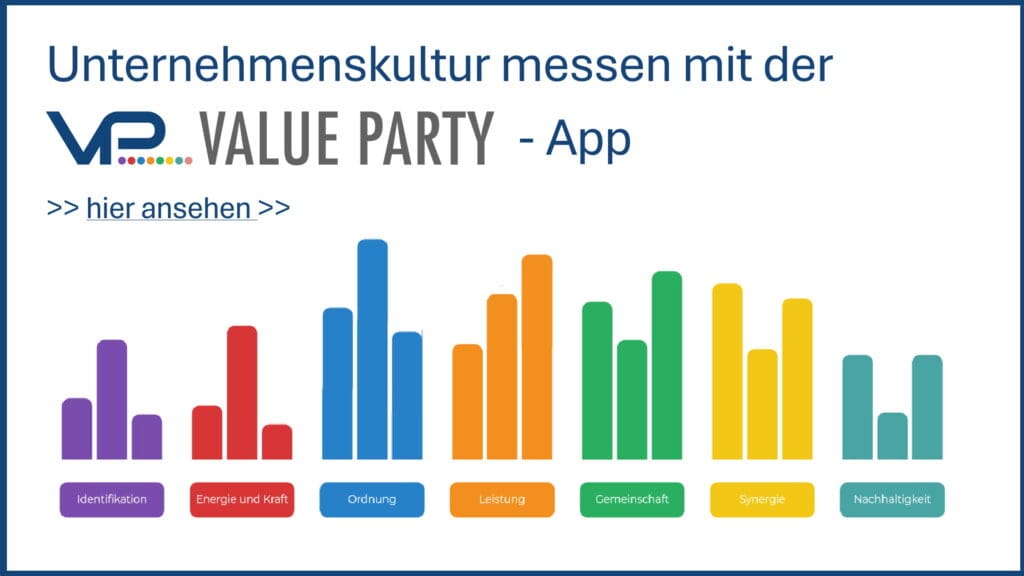
Would you like to try the Value Party app for free?
Then just get in touch with me!
8 Corporate culture as a living concept: How often should it be updated?
Why it is important to regularly review the corporate culture and adapt it if necessary
Adapting to permanent change
We all know that the world is changing: markets and customer requirements are changing, technical innovations are emerging, the political situation is in a permanent state of flux – and all of this is happening quite quickly and unpredictably. There is even a word for this uncertainty: VUCA.
In view of the constant external changes, your company should regularly review and question itself:
- Are we still in the right position?
- Are we still working properly?
- Do we need to change the way we work?
To be successful in the current situation, you need to take a look at your corporate culture, because your culture either supports or hinders your work.
Annual crop survey
We recommend conducting a culture survey once a year, for example with the Value Party app. This way, everyone in the company can easily give feedback on how they currently view the situation in the company. Because once an awareness of culture has been created, this is the easiest and cheapest way to check whether the company’s direction is still right.
Cultural team
We encourage our customers not to simply leave the topic of culture unaddressed after a cultural process, but to establish a cultural team. These are employees who are constantly questioning the topic of culture, working on it, exchanging ideas with colleagues, stimulating and thus keeping the topic of culture alive at all times. In this way, a company ensures a flexible culture that constantly adapts to the circumstances.
Next steps
I send Peter a few codes for the app and links to our articles and our book. He makes a good-humored impression as we say goodbye.
Two weeks later, he gets in touch: He has spoken to his management team; they have tried the app, read a lot and made a list of what is currently difficult in the company. They have decided to have another meeting with me where they are all present. And that’s what we do.

Defining your corporate culture as the key to success
As you can see, describing your corporate culture precisely is fundamental to the success of your company.
The assumption that a clearly defined organizational culture is a dispensable team measure that is done for fun when time and money are available could not be more wrong.
If your goal is…
- …to achieve your corporate goals,
- …to increase employee commitment and performance,
- …to attract the right employees,
- …to avoid redundancies and instead retain employees in the company,
- …to make processes and workflows in the company more efficient,
- …to use team spirit to work across departments,
- …to prevent performance inhibitors such as working to rule and internal dismissal,
- …to identify potential difficulties and developments at an early stage,
- …to initiate solution-oriented, goal-oriented work,
- …to simplify onboarding in order to save working time
- …to defuse conflicts that would otherwise cost a lot of time and money,
then you should deal with your culture instead of working on all the construction sites individually.
After all, achieved corporate goals, lean processes, a team that supports each other and motivated employees not only bring your company a good working atmosphere, but also hard cash.
Cultural change begins
5 weeks later: we have had a total of two meetings with the management team in which we have already discussed the challenges in great detail. Peter’s team has defined goals: they want to clarify and simplify processes. They also want the workforce to pull together so that the wrangling stops and they no longer miss out on business. Team spirit would be great, but they are still wary of it. It is important that new employees are found. And a little more innovation would also be necessary.
Peter puts on his most critical face, which he seems to enjoy doing: “That’s quite a lot we want to tackle. Can you manage it?” I smile: “You can do it, we’ll support you.” Peter nods once, then smiles: “Good, then let’s give it a go.”
What is it like in your company?
Do you feel that something needs to change – but don’t know exactly where to start? Let’s talk. In our free initial consultation, we’ll find out together what’s good for your culture.
And if you have any questions about corporate culture and change management, just get in touch with me!
What are your experiences on the topic of corporate culture? And what topics would you like to see in our blog? Please feel free to leave us a comment.
Define reading and media on the topic of corporate culture
Read more about Values and corporate culture Definition
Corporate culture
Values
More
Employer branding: How employers attract new employees.